Wednesday, 16 September 2009

Bolivia Part 2 - Hunt for the missing Charrangos, Explosions & the stuff of dreams

Leaving La Paz we decided to head on & continue our Charrango hunt, heading for the supposed 'Bolivian Charrango Capital' - the small village of Aiquille. To get there we passed through the city of Cochabamba, staying for a couple of nights, which had little of interest to offer. Moving on down to Aiquille we arrived to find a town that appears to live on a diet solely of deep fried chicken & chips, literally all we could find to eat anywhere for both dinner & breakfast...nice!

The local dialect out here in the middle of nowhere was almost like a completely different language, & we really struggled to understand or make ourselves understood - possibly a contributing factor in the fact that we could not find a Charrango workshop for love nor money, apart from 2 shops that had a poor collection of badly made instruments - far fewer options than anywhere else we had been so far in Bolivia. Eventually we decided to throw the towel in on the Charrango hunt & get the hell out of Aiquille & onto somewhere that resembled civilisation again...easier said than done when you are in the backwaters of Bolivia - the next bus not passing through the town until 2am the following morning. Not feeling like another few meals of chicken & chips we decided to hunt down a taxi driver to ferry us the 3.5 hours onto Bolivia's 2nd city of Sucre.
So we found a guy who had a taxi sign in the windscreen of his battered old Toyota (everything is old Toyota's in Bolivia - most of Peru & Ecuador as well in fact) - complete with 2 entirely bald back tyres & we negotiated ourselves a reasonable price for the journey, on the condition that he got his tyres changed before we set off - agreeing to this, he told us to return in an hours time when he would be ready to go. So return in an hours time we did to find the tyres still completely bald & our taxi driver dressed up in a dentists uniform tending to patients! After going through the routine of him saying 'oh I didn't think you were serious' he proceeded to shut up his dentists practice for the day, grab a packed lunch off his Mum (chicken & chips naturally) & we set off down the road to get the tyres replaced with some that had marginally more tread on than the previous pair, & we proceeded on down the 3.5hr dirt track journey to Sucre.
Our drivers name was Jhonny & he was actually a really nice very chatty bloke, telling us all about how he studied for 6 years to be a dentist, though has to double up as a taxi driver to supplement his income - often making more from a days taxi-ing than dentistry. He also told us that he was one of only a handful of people in Aiquille with any form of education at all, most of the people there, as in many places in Bolivia have no education at all, children being put out to work shining shoes, begging or whatever when they should be in school, resulting in large sections of the population being almost completely illiterate save for possibly being able to write their own names.

Everywhere you go in Bolivia - even in the smallest towns, the only form of advertising you see is not billboard posters, but houses or buildings painted with one of two things - either a branding of a mobile phone company (in places where it is hard to believe that many people can really afford a mobile), or political sloganeering. The current Bolivian president - Evo Morales, who has been in power since 2006, is the first Bolivian president of indigenous background & heritage, providing Bolivia with one of the most stable politcal periods it has ever known & even though he has left many promises unfullfilled since he came to power, he still remains incredibly popular - particularly among the people of the Altiplano (highlands). Everywhere there are slogans of 'MAS EVO' - MAS being both an acronym for the party name (Movimiento Al Socialismo) & being the Spanish word for 'more'.

As head of the Socialist government, Evo Morlaes is a self styled United States worst nightmare in Latin America. The parties main objectives are to provide more power to the indigenous communities via land reform, re-distribution of gas wealth & by heading up a movement to resist the eradication of Coca production in Bolivia - as being enforced by the US. Coca obviously being the raw ingredient used for making Cocaine - though the unharmful raw leaf is a large part of Andean culture, used for chewing & making a tea type drink called 'Mate', & has a tradeable value in its own right offering a form of income to otherwise poor farmers.

Bolivia is also the country where the CIA finally killed Che Guevara in the '60's, & when you think about it it is exactly the sort of thing that Evo Morales is now doing that Che Guevara was trying to encourage at the time - it's just taken some 40 odd years after his death for it to start to become any form of reality here!
Things weren't always this way for Bolivia though, & during the Spanish colonial days the cities of Sucre & especially Potosi were among the richest cities in the world, up there with Paris & London due to the amount of mineral wealth in the mountains. Sucre today still maintains an aire of grandeur about it, & the wealth of grand colonial buildings that line its streets are still whitewashed every 2 years to keep the place looking pristine.
Sucre is now the university city of Bolivia & its streets are filled with the more fortunate Bolivian's who are able to get an education. Sucre definitely has the nicest feel about it of all the built up places in Bolivia we have visited so far with a lively cafe & bar culture. While here we treated oursleves to the rare luxury of a nice hotel for a few nights - after several nights of some pretty grim accomodation out in the Bolivian hinterlands.

After Sucre we headed south onto Potosi - the wealthiest of all the cities in the America's in the 1600's due to the mountain full of silver that overlooks the city. The mountain is called Cerro Rico (Rich Mountain), & has been plundered for hundreds of years to now within an inch of it's life at great human expense, as the unregulated mines regularly have children as young as 11 or 12 working there & the amount of deaths during the main silver rush period stretched into the thousands.
Potosi today has kept its grand colonial buildings around the main plaza, though the surrounding areas & suburbs no longer bear any signs of a once great city, with poverty now rife. While here, Claire & I took a tour out to the mines, which is a pretty mad experience. On the way to the mines we stopped off at a miner's supply store where you are encouraged to buy dynamite to give to the miners as a gift. Freely available over the counter for anyone to buy, we bought a couple of sticks of dynamite complete with fuse & accelerant all neatly packaged into a little bomb bag & got back on the bus - now loaded with about 20 sticks of dynamite & carried on up the road...feeling somewhat vulnerable!
We made our way into the mines, fully kitted out with helmets, head torches & dynamite & proceeded to make our way down the shafts into the bowels of the mountain. Resembling pot holing more than it did mining, we crawled on our hands & knees through mine shafts about 3-4ft in diameter, heading down steep & slippery angles deeper into the mountain. There is no ventialtion once you get into the mine & the heat & the dust is pretty uncomfortable, temperatures reaching up to 40 deg C. The miners here regularly work between 12 & 24 hour shifts, the drink of choice to keep them going is a mix of lemonade & a spirit which is 96% proof, resulting in many drunk, tired people working in these horrendous conditions, so naturally accidents & deaths continue to be a major part of daily life.
Deep in the mine we sat & had a chat & shared a little of the potent drink with a family that had formed an independent mining company. By law you have to be 18 to work the mines, but no one regulates it at all. The youngest of the brothers we met claimed to be 17, though was clearly no more 14 or 15 at most. Our guide told us this was not unusual, & there are still regularly kids of 11 or 12 who act as the goffers for their brothers & fathers down here. While we sat chatting to them a series of 3 dynamite explosions went off in the tunnels below - an unnerving experience as the entire place shook. Due to the fact the mountain has been mined so heavily over the years it is now proving more difficult to find any veins of silver, & as a result they have started blasting shafts within 12 meters of other tunnels - the safety standard apparently being 30 metres between tunnels, making the potential for collapse now much greater...obviously they don't actually tell you this until you are well & truly inside the mine!
We clambered our way back up the rabbit warren that is the mine shafts, pleased to be back above ground. It was here that the guides set off the few remaining sticks of dynamite we had left, so from a relatively safe distance we stood back & watched the bombs go off - health & safety being even less of a concern in Bolivia than it was in Guatemala apparently...

The locals of Potosi say that Cerro Rico stands like a tombstone over the city, & after seeing a little of the daily realities inside the mine it is easy to see why.
We stayed at a nice hostel in Potosi which was really good for meeting people, & from here we hooked up with a group of travellers & jumped on yet another bus (7 hours off road) & made our way down to the star of the Bolivian show - the Uyuni Slat Flats & surrounding otherwordly landscapes that lead down to the Atacama Desert & the Chilean border.

Our group consisted of our driver, Ronaldo - & the 6 of us. 2 Spanish girls, a Swiss guy & a half Mexican / half English guy - all of whom were really good company for the 3 days we spent together, witnessing some of the most bizarre & impressive landscapes you are ever likely to see. We decided on a 3 day tour, tailormade to our requirements as we wanted to cram as many of the sights in as possible, but still leave Bolivia at its southern most tip and enter Chile at San Pedro de Atacama.

The first day was spent predominantly on the Uyuni salt flat - a 12,000 sq km expanse, making it twice the size of the Great Salt Lake in the States, & the largest in the world. Driving across the salt offers a bizarre sight, brilliant white hexagonal salt formations in all directions, with the cones of ancient volcanoes intermittently poking through the salt crust creating islands, some covered in cactii up to 12 metres tall. The clear blue sky & the pure white of the salt create mirages on every horizon, that act as mirrors against the islands, & give them the appearance of floating in space.
Considering the size of the salt flats, it is reassuring to know that there is only an area of some 20 sq kms that is set aside for salt extraction for commercial purposes. Little mounds of salt of 3ft high litter this area while the salt is left to dry, as the moisture evaporates ready to be taken away for processing. None of this salt is exported, all of it being consumed soley within Bolivia. The rest of the salt flats is a natural reserve, however it has been discovered that beneath the salt flats lies up to half of the worlds remaining reserves of Lithium - something that is in ever greater demand in our battery hungry societies. The main source of interest for this Lithium is for use in providing power to the super powered batteries required to run Hybrid & Electric cars. Currently the Bolivian government has given an area of the suppossed reserve over to a French company for Lithium exploration. The downside of all of this is that in order to access the Lithium they have to completely remove all the salt - so in theory if enough Lithium is found & enough companies wave enough cash at the economically crippled Bolivian Government, the salt flats could completely disapear in a relatively short space of time.

The more you hear about the negative side effects of producing these so called énvironmentally friendly´vehicles (massive deforestation to make way for Bio-fuel crops, pushing the cost of the crops way above the affordable level for many of the people in 3rd world countries where they are grown & who rely on them for food, the potential disapearance of the salt flats etc...) makes you realise what a complete farce it all really is. The sooner Hydrogen powered vehicles become a more feasible reality the better - it´s not like we would drain an Ocean or anything... ;-)

We end the day at a small town called San Juan where we visit the Necropolis, an ancient burial site of the Ayamaran people where mummies were found in petrified coral tombs that date back over a thousand years.

On day 2 after a cold night in a very basic hostel room, we cross through the other side of the Salt Flats and through to the Valley of Rocks, a high altitude desert terrain (Siloli Desert), with red rock landscapes all around, mountains of multiple colours due to the variety of mineral content and rocks that have been battered so heavily by the elements over millenia that they now resemble the shape of trees.

We move on visiting red, green & white lagoons all filled with pink Flamingoes until we reach the second nights accommodation at Laguna Colorada (Red lake) some 4278m above sea level, so named from its red colour caused by the effect of the wind and sun on the microorganisms that live in it. The shores of the lake are encrusted with Borax and so provide a bright white backdrop.

Nightime is especially cold and was even more so here were the temperature dropped to below minus 20C, & the basic accomodation we stayed in for the couple of nights spent out here obviously had no form of heating. We were sleeping in all the layers of clothing we had, wrapped in a sleeping bag under 2 blankets & were still cold!

Day 3 was a very early start (4am) to catch the sunrise at the 'Morning Geysers' an hours drive away. We arrive to the smell of sulphur, gurgling mud and spewing smoke & water high into the air. We continue on to an area called ´The Desert of Dali´due to it´s resemblance to the surrealist dreamscapes of a Salvador Dali painting.
The entire trip is carried out at above 3500m´s, reaching almost 5000m at the highest point, & unless in direct sunlight it gets painfully cold. A small price to pay though for what you see - all the weird & wonderful landscapes combining to make it feel like a completely different plant.
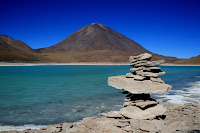
It was here in the middle of the desert, beside a towering 6000m volcano & a bright green lagoon (Laguna Verde) that we jumped out of our 4WD & crossed over the Bolivian border into Chile. Bolivia is definitely a country that generates strong feelings - some of it incredibly frustrating, some of it incredibly sad & some of it that might just qualify as one of the best places you are ever likely to visit - all in all a fantastic experience & a great 3 weeks. Hasta luego Bolivia!
Wednesday, 9 September 2009

Bolivia Part 1 - Copacabana, La Paz & Sorata

Travelling around Lake Titicaca, the 3 of us crossed the border into Bolivia, never ceasing to be amazed at how painless border crossing can be in other countries... no questions, no interogation, no bag checks, just a fresh stamp in the passport and on our way. We took a waiting minibus from the border to the nearest town called Copacabana - fortunately Barry Manilow was nowhere to be found! We found a nice little hostel just off the main plaza which set us back about 3 quid a night and planned to take a boat out to the supposed birthplace of the Inca empire, Isla de Sol (Island of the Sun), the following morning. The boat dropped us at the north end and we walked the length of the island down to the south where we were picked up again, 3 hours later. It is quite an attractive island varying from barren volcanic landscape in the north to green fields and quaint villages in the south. This island is much more geared for tourism than the Islands on the Peruvian side of the lake, with plenty of restaurants and hostels dotted about. To the east you have a clear view of the snow capped mountains of the Bolivian Cordillera Real, made to look considerably closer then they actual are by the high altitude thin air and crystal clear blue cloudless skies.

The following day we took a bus to the Bolivian Capital, la Paz, completing our trilogy of the 3 highest capital cities in the world (Bogota, Quito and La Paz), with the El Alto area of the city over 4000m above sea level and the city centre set in a huge canyon at a mear 3600m. The La Paz city limits stretch far and wide within & up the walls of the canyon, an impressive site by either night or day.

Bolivia is one of the poorest countries in South America and suffers from the greatest level of political instability - with something like 100 different presidents over the last 150 years, many of which have been overthrown my military coups. With this in mind we were expecting to find Bolivia considerably less expensive than neighbouring Peru but this was not to be the case, in La Paz at least, where they have got wise to the prices they can get away with charging tourists.
Coming from the tranquility of Lake Titicaca, the chaotic nature of La Paz hits you hard, probably the craziest, most manic city we have been to! The locals stalls line the pavements using every available inch as a market place, making walking on them impossible - so you have to take your chances walking in the roads, avoiding the mass of taxis and smoke churning buses that weave their way throught the streets. All the chaos is actually quite endearing and there is a real energy and vibrancy to the place. It is not on any level 'European' in its feel unlike some of the other cities in South America we have been too, and there is little refinement and few luxuries to be found, though there are a few nice cafes, bars and restaurants.

Our hotel was right in the middle of the market district, which includes a ´witches market´where you can buy any number of potions and lotions to cure all manner of ailments including those of the heart, and each stall selling an array of llama foetuses known to drive away evil spirits if you bury one in the grounds of your home. Providing all these llama foetuses does not involve any cruelty though, as apparently each llama always gives birth to 2 baby llama but one is always still born... nothing goes to waste in this place!

Pirate CD´s and DVD´s are widely available in all Latin American towns and cities, although Bolivia takes this to another level with actual shops trading in them.... we stocked up on a few and thought we would give them a go and were surprised by the excellent quality - and they were even in English like they told us they would be.
Having missed out on the Mexican wrestling while we were in Mexico City due to the swine flu epidemic bring the city to it's knees, we were pleased to discover that Bolivia has it's own version. So we got ourselves some tickets & took a bus along to what was a cross between a village hall & a run down sports hall, with the majority of one end of the building completely missing & 'blocked off' with an ill fitting piece of tarpauling. La Paz gets down below zero in the evenings this time of year, so it made for quite a chilly experience - but a very funny one at that. The funniest parts being provided by a number of women who were dotted around the audience, all decked out in their full indigenous outtfits, sitting there knitting or something else unassuming, and at various intervals they would jump up out of the audience & get in the ring & start beating the hell out of each other - looking far more aggressive than the men as they strangled each other by their pony tails & threw each other around the ring. Obviously it is all choreographed to some extent, but some of the moves must actually hurt...either that or they are really good actors...

Checking out the La Paz nightlife we hit a few bars that had been recommended - the first of which was like a really bad Yate's pub from back home, bad music being played way too loud with sticky carpets & hidiously drunk people all over. Moving swiftly on from there we went to a bar that had an industrial feel, & was set out like something out of Nightmare on Elm Street, complete with various painful looking implements hanging from the walls & ceiling & a blow torch constantly burning at the bar ready for any requests for flaming sambuckas or unwanted hair-do's... The final bar we went to had a U2 tribute band on - U2 being Leanne's least favourite band & with her being somewhat drunk by this stage of the evening, she morphed into Jonny & started heckling the band between each song, letting them know exactly what she thought of U2. Shortly after which we made our excuses & left...

La Paz has a couple of streets where there are a whole host of musical instrument workshops producing handmade instruments. We were in the market for a couple of Charrango's - an Andean instrument like a tiny guitar but with 10 strings & different tunings, though managed to get a bit side tracked by a handmade cedar wood acoustic guitar that caught my eye for all of about £30...naturally I couldn't resist & with that added yet another cumbersome item to our 'to send home' pile. In the post office the following day we were pleasantly surprised to find that it cost less than £20 to send the guitar home, & even more pleasantly surprised to find out it actually made it home in about 3 weeks. All I need now is for it to actually be in one piece...

Taking a short leave of city life, we headed out of La Paz to the mountain village of Sorata for a few days. Leanne at this point decided she still had some unfinished business to attend to back in Cusco, Peru, so we went our seperate ways again, Claire & I heading onto Sorata & Leanne taking a bus back up the way we had just came to meet up with the Irish again in Cusco. We did say that Cusco was the sort of place you easily spend a lot of time in...

The locals of Sorata claim that this was the original location of the Garden of Eden - whilst there's no denying it's a very beautiful place, I think this claim might be stretching it some what. Claire & I went on a really nice 1 day hike out to some caves & back along the side of a river canyon. However, what was a real shame to see en route was the Bolivian version of waste disposal - which due to the fact there is no recycling here or very few actual designated rubbish tips, the government truck that had just collected all the towns rubbish was literally tipping the contents of it's load off the side of the mountain road down the side of an otherwise beautiful valley & into the river below.
Leaving Sorata we headed back through La Paz for another night, attempting to make a visit to the open prison of San Pedro - as made famous in the book 'Marching Powder' - which was once open to tourists for visits, though now has been completely closed off in this respect by the authorities. There are no guards on the inside of the prison & prisoners have to buy their own cells, the most well off prisoners living in appartment style confinement, the poorest of which live in the worst squallor imaginable. Due to the fact that many of the families of the prisoners have no means of income whilst their bread winners are locked up, many families actually live in the prison with the convicts - including children who leave the prison daily to attend school. So we said goodbye to the mayhem of La Paz & made our way south.

Thursday, 27 August 2009

Peru - Part 3, The road to Ruins... Cusco, Machu Picchu & Lake Titicaca

From Arequipa, we jumped on what proved to be our last luxury Peruvian bus for the overnight trip to Cusco. Claire and Leanne had both been there before some years earlier and had both loved it but were a little apprehensive after hearing a number of traveller tales through Peru about how a lot of the charm was now lost due to the volume of tourists. Any apprehensions were soon forgotten when we settled into a hostel in the San Blas area of town and took a wander around.... more tourists, yes, but still the beautiful city it was and no real grief from anyone, in fact all the locals could not have been friendlier! Whilst there is no denying it is hugely touristy in places and literally every shop is either a tour operator or an artesanial shop, it still has an energy and great character to it, and it is quite easy to spend a lot of time here...

We arrived feeling slightly homesick for some good pub grub and beer and where better to indulge than the Irish Pub.... blasphamy i know but after a good old homemade shepherds pie, beef casserole, a few pints of IPA on draft, a game of rugby on the tv and some typical english/irish banter, we could have been back home for sure ... great!
The San Blas area of Cusco is known as the bohemian area of town, filled with small bars, restaurants, clubs and cafes etc and although the hostel we were staying in was one of the cheaper on offer, it had everything we needed - but managed to employ the most inept staff of anywhere we have stayed. The guy on reception had to ask our names on a daily basis just to check his bookings were correct.... after staying there for 5 nights, he still had to ask who we were when we checked out....


We spent a few days in Cusco taking in the place, visiting the artisanal market in nearby Pisac & looking into the various options for taking a trip out to Machu Picchu. Things have definitely got substantially more expensive the further south we have travelled in Peru - which is to be expected as the majority of the major tourist attractions are in the south, though you have to keep on eye on what you are doing with your money, as at every turn someone will attempt to short change you, over charge you or generally look for any way to get more cash out of you. Something that is certainly true when it comes to Machu Picchu.
If you want to do the original Inca Trail, not only do you have make a reservation months in advance, but it will also set you back around $500 for the 4 day trek. There is also a train line that goes direct from Cusco to Aguas Calientes - the town at the foot of the mountain Machu Picchu is perched on, which only takes about 4 hours & costs $96 for the cheapest tickets - a price which has more than quadrupled in the last few years alone. There are a couple of ‘alternative’ hikes you can do, none of which actually allow you to arrive at Machu Picchu via the traditional entrance of the sun gate - all end in Aguas Calientes & you have to get the bus up the mountain the following morning.

Not feeling particularly inspired by any of those options, & being a bit trekked out after our time in the Cordillera Blanca we decided for the cheapest option of taking a mini van. However, there is no direct road from Cusco to Machu Picchu, so you have to take the long way round across the mountains & through the jungle before arriving at a hydroelectric plant which is connected via a 30 minute train ride to Aguas Calientes where you spend the night. Getting to the ‘Lost City’ should not be an easy task, & even in a car it is a pretty arduous 9 hour journey, over half of which is on unmade dirt tracks. One particular stretch that actually goes on for about 2 hours - is a track that has been scratched into the side of the almost vertical mountains with a sheer drop several hundred metres down to the river below, barely wide enough for 2 vehicles to pass (though of course is a 2 way ‘road’), & has rocks strewn all over it from the crumbling hillside where the track has been so roughly cut. Naturally none of this is tackled using a 4WD or anything, just a clapped out old Toyota mini van filled to bursting with ‘eager’ tourists…

When you arrive at Aguas Calientes the place is absolutely awash with tourists & everything is priced accordingly (basic hostel rooms can cost in excess of $50 a night if you turn up & try & get one off the cuff). Anyway you have to spend the night here, then get up at 3.30am to go & stand in a queue to buy your bus tickets - the ticket office doesn’t actually open until 5am & the first bus doesn’t leave until 6am, but if you want to stand a chance of being in the site for dawn you need to be on the first couple of buses that leave. You then have to join another queue for the bus itself, take the 20 min bus ride up the mountain, then join another queue at the gates of Machu Picchu waiting for them to open up at 6.30

Thankfully for our efforts we managed to get on the 2nd bus that left town & were amongst the first couple of hundred people to enter the site. Once the gates opened & we walked in suddenly all the hassles faded away & all the effort became worth it. The entire place was still shrouded in morning mist & dawn was just starting to break, initially hardly being able to see any of the site. Then as the mist began to rise Machu Picchu slowly started to reveal itself to us, a surreal & magical sight that is one anybody who experiences will never forget, & it all becomes clear why this is such an iconic place that attracts visitors in their thousands every single day. Pictures only tell part of the story with this place & it really does have to be seen to be fully appreciated. Believe the hype, ignore the hassle involved in getting here, book a flight to Peru & come see it for yourself!

Returning to Cusco we spent another few days enjoying the city & visiting the nearby ‘Sacred Valley’ (so named by the Incas as apparently the River Urubamba that runs through the valley mirrors the Milky Way) taking in two more impressive Incan ruin sites of Pisac & Ollyantaytambo before Claire & I left Cusco & moved onto Lake Titicaca - Leanne deciding to stay on in Cusco a few more days with the Irish girls.

Lake Titicaca is widely referred to as ‘ the highest navigable lake in the world’ - a claim that is now disputed by some, but either way at 3856 metres above sea level it is up there as one of them. And it is big - huge in fact, more an inland sea than a lake it is roughly 8,500sqKm & some 200m deep. It is roughly the size of the country of Corsica, & is shared 50/50 between Peru & Bolivia as it straddles the border.

From the lakeside town of Puno, Claire & I took a boat out to the floating islands of Uros, made from the same Tortora reeds as the fishing boats in Huanchaco, they are man made islands where a community live. Originally developed several hundred years ago by a tribe of people wanting to escape the mainland & have autonomy over their own actions & decisions - as no standard Peruvian laws applied to them on the islands. Sadly they are now little more than a floating theme park for the benefit of tourism. The smell of money being enough to bring conformity to a group of once staunch non-conformists apparently...

From Uros we travelled another 3 hours out into the lake to the island of Amantani - where Spanish is still very much a second language (Quechua being the first), there are no vehicles, no hostels/hotels, no restaurants & very little electricity save for that provided by a few solar panels dotted around - but despite all of this it actually attracts its fair share of overnight visitors. With no traditional means for supporting tourism on the island, the community have developed their own co-operative where on a rotation basis & for a flat rate fee of c. £5, families take it turn to welcome guests into their homes & provide board & lodgings for them. The family Claire & I stayed with were lovely & made us feel very welcome in their modest home. It was like something out of Alice in Wonderland, as the average person on the island is substantially shorter than your average European, & the height of the door frames barely reached my shoulders!

The food they made for us for the 3 meals we shared with them was really nice, being a completely vegetarian island for the entire year with the exception of 2 annual fiestas where they sacrifice animals & eat the meat, the meals consisted of imaginative ways of making potatoes & quinua interesting, including some really tasty soups.


The following day after a rather cold night on Amantani, we sailed across to the neighbouring island of Taquille - steeped in traditions & customs of it’s own. A place where the colour & angle of a mans hat indicates his marital status, & the angle the women’s shawls hang across their faces indicates their marital status, where women have to walk a couple of meters behind any man due to the ‘macho’ beliefs, though bizarrely men walk the streets & sit around the squares openly knitting!


The following day back on the mainland in Puno, Leanne rejoined us, having managed to escape the clutches of Cusco (this actually being her 2nd attempt to leave, the first being hindered by her bus ticket being burned in the pub by an Argentinean guy whilst having leaving drinks). From here we waved goodbye to an amazing 5 weeks in Peru & drove to the other side of Lake Titicaca crossing the border into Bolivia.

Peru - Part 2, Mysteries of the desert & Canyon country

Claire & I arrived in Lima & met up with Leanne & Ruth (one of the Irish girls we met in Montanita) where we all jumped on a bus down the coast to a little desert oasis town called Huacachina. Leanne’s week of surf & Spanish lessons in Lima hadn’t exactly gone to plan, not managing to further her surf career unfortunately, though she did manage to get some 1 on 1 Spanish lessons - which consisted of meeting up with an overly tactile middle aged ‘teacher’ in McDonalds every day for a lesson & gourmet meal…the several nights of heavy drinking & partying that ensued were obviously a necessary antidote to the rather bizarre lessons.


Huacachina is a funny little place, literally a very small town built around the banks of a picturesque desert oasis - surrounded by huge towering sand dunes. The key attractions of this place are chilling out, partying, sand boarding & dune buggying. After a night of partying & a day chilling out, Claire & I decided to go on one of the dune buggying & sand boarding trips - Leanne & Ruth opting for the more chilling option until a few days later when they would give it a go as well. Most of the boards available are just basic pieces of wood , modified with a slippery base & straps for your feet or hands. A couple of places offer actual snowboards with boots & bindings, so Claire & I decided to upgrade & go for the snowboard option.

We set out at 4pm in the buggies for a 2 hour trip that would include a desert sunset. Within the first couple of minutes it became apparent that the dune buggy drivers are totally psychotic & our guy proceeded to drive this thing at full throttle over the huge expanse of desert & dunes - regularly taking flight as he launched us over the top of another dune. This was like something out of the film Mad Max - really good fun. We had several stops at the top of some of the largest dunes to board down them. Very similar to snowboarding in deep powder, as its all about keeping the nose of the board out of the sand. We had a real laugh launching ourselves down the dunes, even managing to incorporate a jump over the lip of one of the dunes down into another - great fun.

There are several common themes that are beginning to define elements of our Latin American experience - the first of which is the seeming inability of anyone to actually tune a radio in - every radio drifts in & out of reception & is full of static the entire time - even on the buses. Our first tip to Latin Americans to make life better for all concerned would be either learn how to tune a radio in or turn the damn thing off. The second common theme is the utter uselessness of all waiters & waitress’ in every single restaurant. Items ordered are regularly completely forgotten, they literally cook one dish at a time & bring it out one by one (even if it is multiple orders of the same dish) - meaning that you never actually eat together around the same table, everyone sits there watching each person take their turn of eating. The staff have also perfected the ability to avert their eyes from the entire restaurant the entire time, so it is impossible to get their attention without actually getting up & tapping them on the shoulder. The time that you regularly have to wait to receive your orders is ridiculous as well - something that pushed us to breaking point one night in Huacachina. We ordered our meals (after waiting over 30 mins for the waiter to come to our table) & it then took another hour & a half until the first dish came out - all the while Peruvian families are being served in record time & meals arriving together. So after consuming several beers & one meal between 4 of us, we got up & walked out, still waiting for 3 meals to arrive, without leaving any cash - appalled at the lack of service & motivation of the staff. Tip number 2 - the idea of running a business is to make money, in order to maximise your profits, learn the basics of your trade first & then try actually carrying them out!

Rant over.

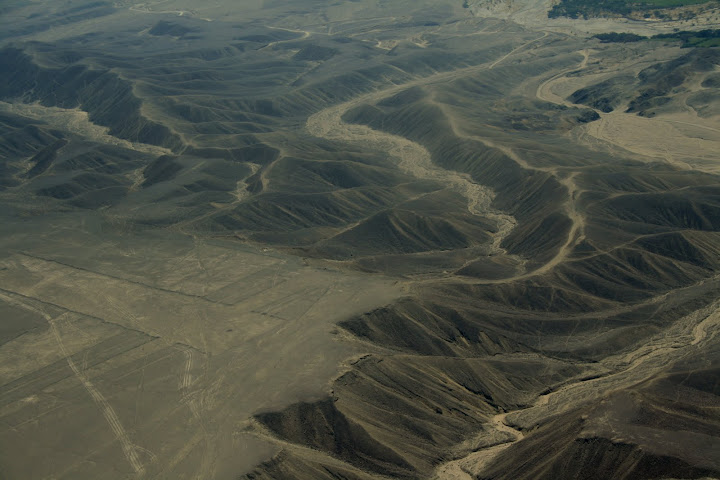
Next we continued south through the Peruvian desert, a dramatic landscape originating from an antient sea bed, to the town of Nazca to checkout the mysterious Nazca Lines. The best way to view these giant ancient etchings in the desert is by air, so we chartered a small cessna plane and took to the sky. The Nazca lines consist of hundreds of perfectly straight lines in the sand at various angles as well as a variety of shapes or drawings of animals & symbols such as a spider, hummingbird and whale, all several hundred meters in size. No one actually knows what the meaning of it all is although there are a variety of theories ranging from the reasonably plausable to the utterly ridiculous (extra terrestrial landing directions being one of the the more ridiculous theories!) They are believed to date back some 700 years and were only really discovered about 50-60 years ago. The most believable explanation for the straight lines are they are indicators left for successive generations, of the water sources available in anotherwise desolate desert landscape.

This doesn´t offer any explantion to the animals & symbols drawn into the landscape however like the spider below:

Seeing them first hand is an unusual and fairly impressive sight, though you have to hold onto your stomach during the flight as the pilot flips and turns sharply to allow all passengers a good view! A french girl in front of us managed to fill a number of plastic bags with vomit whilst her boyfriend sat there with a complexion ranging from ghostly white to green and sweating profusely! Thankfully the flight only lasts 35 minutes by which time the rather unpleasant aroma that had developed in the plance and the constant flipping around had started to make me feel queasy as well....not helped by the ham and cheese toastie, 2 cups of coffee and slice of cake i had just eaten before boarding the plane, thinking we had over an hour until our flight!

Nazca is also home to the the worlds largest sand dune.... Cerro Blanco is over 2000m high which is the height of 2 Ben Nevis´s stacked on top of each other of just sand... impressive.

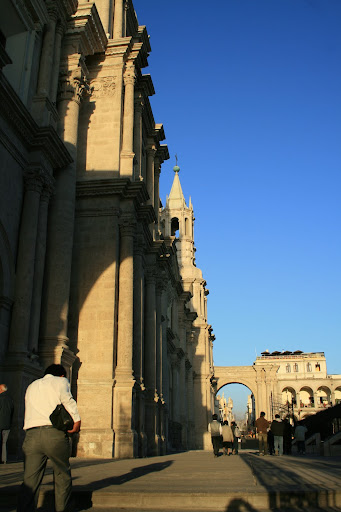
After a fleeting visit to Nazca, we jump back on a bus and headed back down the Pan American highway and headed further south through more rugged desert landscape for the next 8 hours until we reach the colonial city of Arequipa, otherwise known as ´el ciudad blanco´, the white city as a lot of the buildings are built using a white volcanic rock known as ´sillar´taken from the several volvanoes that surround the city. The most impressive of which is El Misti which is not only over 5000m but is the perfect conical shape generally associated with a volcano.


Arequipa is a beautiful city made up of spanish colonial and moorish style architecture and with a host of moroccan and turkish restaurants, has a completely different feel about it than any other Peruvian city we have visited. It is also a major tourist destination & a visit to Peru would not be complete without coming here and visiting the famous Colca Canyon and ´Juanita´, the ice princess. Juanita was a teenage girl offered as a sacrifice by the Incas to the mountain gods in cerca 1500ad. Her perfectly preserved body was found in the 1980´s after a minor erruption dislodged some rock and unveiled her body, sitting in the foetal position, adorned with all sorts of material offereings. Apparently this was a regular practice of the Incas who worshiped the earth, the sky and the mountains and sacrificed (usually) young girls to the volcanoes to appease their anger and prevent erruptions.

After a couple of days milling around Arequipa and enjoying the delights of some good food in nice restaurants, we sign up to one of the tours going to the Colca Canyon. The Colca Canyon is twice as deep as the Grand Canyon in North Amercia and stretches for several miles along the Colca Valley, awash with inca terraces and inca burial sites which are still used by many indigenous communities today.

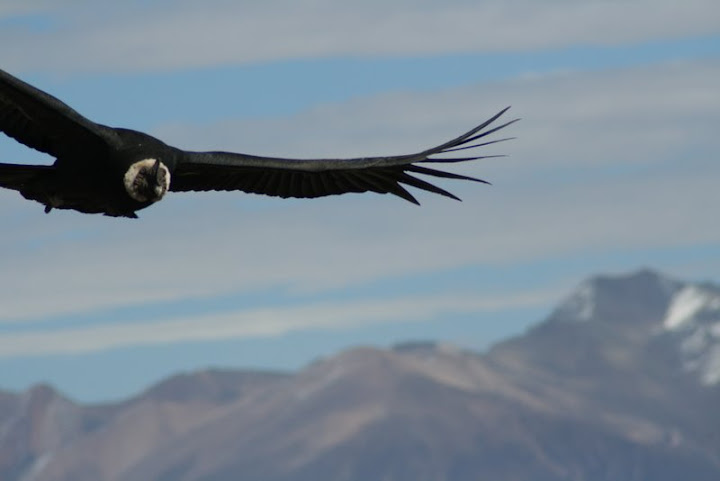
The main reason people make the 2 day trip is to travel to a specific point along the canyon where the Andean Condors take to skies in search of food. We stayed overnight in a small town called Chivay on route along the Colca Canyon, and woke very early (5am) for the bus ride to the view point. Bang on schedule between 8am and 9am, up to a dozen or so condors, some with a wingspan of up to 3m, start to leave their nests and soar on the canyon thermals for an hour or so before heading off in search of food. It's an impressive sight to see such huge birds, gliding so effortlessly only metres from you head.

Other highlights include seeing wild vicuna, domesticated alpaca and llama and many indiginous communities in an array of different colourful dress, descendants from Inca times and the different communities are still identified by the different types of hat they wear.


Wednesday, 29 July 2009

Peru - Part 1, Touching The Void...kind of

So we took the 9 hour bus journey from Loja in Ecuador, through more stunning mountain scenery across the Peruvian border into the city of Piura, where we were meeting up with Leanne again the following day. Piura itself has little to hold the attention of most visitors, so we just stopped a couple of nights before getting on another 9 hour bus journey down the Pan American to the Peruvian city of Trujillo.

Looking out the bus window on the long journey through a small portion of the northern section of Peru, largely following the coastline, first impressions were of large expanses of vast emptiness, combined with intermittent sections of very tall, very badly built brick walls…

We decided to base ourselves just outside of Trujillo in a little surf/fishing village called Huanchaco - a unique surf/fishing village as a result of the handmade reed boats the local fishermen use - called ‘Caballitos de totora’ which they kneel on, paddle out, catch the fish & surf the waves back in to shore again.

We were expecting Peru to be significantly more expensive than many of the countries we have visited so far as it is a much more established tourist destination due to the like of Machu Picchu etc - but we were surprised to find it to be one of the cheapest places we had been so far (at least in Huanchaco). We had a really nice hostel that was £3 each a night, we could eat a really good 2 course meal including drink for £1.20 each, & a 2 hour surf lesson including all the gear hire was only £7.

We spent about 4 days here, a few days of which spent surfing, Leanne had a few more surf lessons & made some really good progress, managing to stand up on the board several times. We met some really nice locals here that took us to the local reggae party at a cool beach club, & we made friends with Leanne’s surf instructor, who was really keen to come to England to work so he could earn some good money & further his surf business in Peru. He had some spurious looking job application supposedly from a hotel in London, claiming that they would pay his air fair, arrange his UK immigration visa & pay him the princely sum of around £1500 a year for a job in the hotel under a minimum contract of 3 years. The UK visa email contact details that were given were against a yahoo.co.uk address - which was clearly fake. Unfortunately it looked like he was being lined up to be the victim of immigrant worker exploitation via some illegal organisation in the UK - something that was pretty much confirmed when my sister made some enquiries about it in the UK. A real shame, as he was a really genuine bloke that just wanted to be able to afford a better standard of living.
After a really good few days here we jumped on yet another 10 hour night bus - heading for the Cordillera Blanca mountain range & the main base town of Huaraz. How things have changed in a relatively short space of time when it comes to bus journeys - from the chicken buses of Central America, we are now treated with some of the best buses we have ever been on. We bought the first class tickets (£12 for a 10 hour journey) & it was like being on a private jet - huge leather sofa seats that pretty much fully recline to be like a bed, a meal & drink served to you before take off/departure - suspension that actually works & drivers that don’t appear to be completely suicidal - all in all a very pleasant journey!

The Cordillera Blanca area is the part of the Andes where the mountains are consistently at their highest - although the highest single mountain in the Andes is on the Argentinean/Chilean border, with 33 mountains above 5000 metres, 16 of which are above 6000 metres - the Cordillera Blanca is the second highest mountain range in the world, second only to the Himalayas. The region (or more precisely the Cordillera Huayhash, just down the valley) was brought to wider public attention by Joe Simpson’s tale of his near fatal climbing expedition in the documentary film & book ‘Touching The Void.’

After a day of getting used to the altitude the 3 of us set out on a hike into the mountains, up to the Laguna Churup at 4,450m. This was due to be our ’acclimatisation’ hike in preparation for one of the multi day hike options on offer here. The hike turned out to be a pretty tough 8 hour route, the 4-5 hours of which to the Laguna were all solidly up hill, & the final 30 mins or so was a scramble up the side of a waterfall - which pushed Leanne’s fear of heights to the limit, & whilst she safely made it up & down the route, it was enough to convince her that this sort of activity wasn’t really for her & made plans to leave the mountains for Lima a couple of days later.

However not before Claire & Leanne took a trip the following day out to the archaeological site of Chavin, built between 1200 and 800 BC. The site contains a maze of underground tunnels, ducts and chambers and is considered a huge feat of engineering, particularly as its some 3000 years old. The bus trip to the site was equally as impressive as was the location for the site. The new museum, built only last year, has some great examples of pottery, huge stone deity heads and carvings. Most of the site is still undergoing excavation as in 1970 a landslide following an earthquake, covered the entire site in mud.

I on the other hand spent the day mountain biking with a local guide, famed with pioneering mountain biking in Peru. It turned out to be just he & I, & proceeded to have a pretty amazing day biking. Julio grew up in the area & has basically spent his whole life finding new routes & working out how to link them together. These trails are not your average tourist routes that many of the companies in the area offer - they are largely unknown to anyone other than Julio - so much so that even the other guide that he employs doesn’t actually know them yet. We drove up another 1000 metres or so from Huaraz to about 4100m where we began to ride. Because of the height you start at, the possibilities for long flowing down hills were great, & we rode some really nice trails for an hour pretty much solidly downhill without having to barely pedal at all. We carried on for another few hours after this, climbing & descending, riding through small local mountain communities - getting some weird looks from the locals who clearly couldn’t quite fathom out what the hell we were doing, riding bikes down the trails they use for navigating themselves around the mountain side. It was such a good day that I was determined to spend at least 1 more day riding with Julio before we left the Cordillera Blanca.

The following day we said Adios to Leanne again temporarily as she headed to Lima to hook up with the Irish girls she spent time with in Ecuador, & take up some Spanish lessons & hopefully some more surf lessons, having well & truly caught the surf bug.

Claire & I spent the day planning & arranging our 4 day trek through the Santa Cruz valley. We were picked up at 6am the following morning by our guide & the rest of our group (a couple from Brazil and a guy from Finland), & headed off to the Huascaran National Park (Huascaran being the name of the highest mountain in the area & the whole of Peru at 6,768m) for the start of the trek. We arrived in the town of Yungay for an early breakfast. The original site of the town of Yungay was completely buried in 1970, when an earthquake dislodged a huge part of the glacier on the surrounding mountains, creating an avalanche & landslide that buried 18,000 people alive. The Peruvian government subsequently prohibited any excavation of the site & declared it a national cemetery. The new town of Yungay has been reconstructed right next to the old site.

The scenery around here is absolutely stunning - the unique thing about this part of the Andes is that you are still right in the middle of the Tropics, so the snow line doesn’t even begin until around the 5000 metre mark (weird when you consider that Mont Blanc, the highest mountain in Europe is 4,800m & the peak is snow covered year round…) & there are all manner of tropical plants, lush vegetation & Cactus up to around 4000m.


The hike itself took us through some beautiful glacial valleys, past jade green glacial lakes, over a high pass called the Punta Union at 4760m, all with beautiful views of the snow capped peaks of the Cordillera Blanca around us. The first 2 days were quite demanding with a 5 hour climb on day one to the first campsite and then a steep 4 hour climb to the pass on day 2. The latter 2 days however involve a more gentle descent to the town of Cashapampa, where the trail ends.

Each day we only carried a day pack with food, water, layers, camera etc in and all the camping equipment and food was sent ahead on donkeys - something that provided a bit of drama, as after the first night camping the donkeys went AWOL, & the guys spent the next few hours scouring the area for our donkeys - they obviously didn‘t fancy the prospect of lugging all our gear up the mountain that day - can‘t say I blame them really… They eventually found the donkeys after employing the Andean version of Ethel from Eastenders, & reading the Coca tea leaves to find out where they were. Fortunately it worked somehow & we were back on track.

This is definitely a better way to camp, after a long day walking (average 7-8 hours) we arrived each night at the camp site to have the tent put up, coffee on to boil and dinner being prepared. Our donkey man, Eugenio and his son, Jean Pierre (only 7), pretty much ran past us each day to get ahead to ensure it was all set up for when we arrived…. They can pretty much do the entire 50km+ route in about 10 hours so what they must think of us tourist taking 4 days I am not sure!

Back in Huaraz, we meet for some beers with the others in the group and opt for a day off the next day. Not wanting to seem idol, Paul then books up another day mountain biking in the Cordillera Negra, which is the mountain range on the opposite side of the valley to the Cordillera Blanca - the main difference being the Cordillera Blanca are snow capped mountains, whereas the Cordillera Negra are not - though still exceed 5000m. After 40 km of downhill trails he comes back a little battered and bruised after a couple of minor mishaps….. thinking this is more than enough exercise for a few days, we jump on a bus & head to Lima to catch up with Leanne again.